Last updated: 22 September 2026
TL;DR:
To clean gutters, set an extension ladder on firm ground at a 4:1 angle, clear the downspout outlet first, then scoop debris into a bag or bucket working away from the outlet. Flush the run with a hose from the far end, run water down every downspout until it flows freely, and check that the water discharges well away from the foundation. Clean at least twice a year, and more often under conifers. Single-story homes are a reasonable DIY job. Two stories, steep or mossy roofs and nearby power lines are where most people should hire it out.
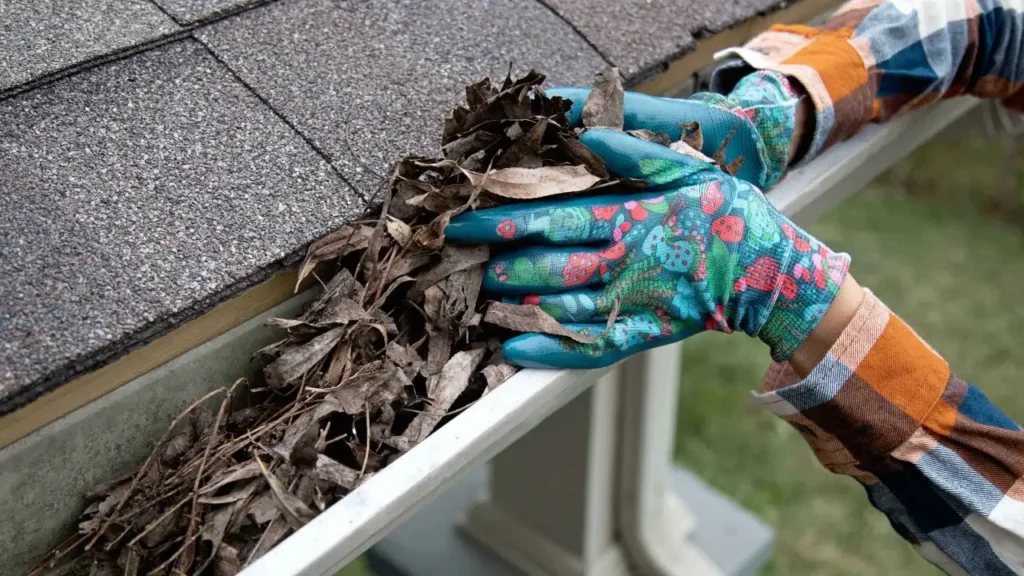
Most gutter guides stop at “scoop out the leaves.” That is roughly half the job. A gutter can look spotless from the ladder and still spill over the front edge at the first heavy rain, because the real blockage is in the downspout, in the elbow at the bottom, or in the pipe underground.
This guide covers how to clean gutters from start to finish: setting the ladder so it does not slide, getting the debris out without dumping it on your flower beds, proving the downspouts actually drain, and checking where the water ends up. It also covers the ground-level tools that work, the ones that do not, and the point at which you should climb down and call someone.
Should You Be the One on the Ladder? A 60-Second Check
Answer this honestly before you buy a scoop. Ladder falls are not a rare accident that happens to other people. A national study of emergency department data found an average of 136,118 ladder-related injuries treated in U.S. emergency rooms every year, and 97.3% of them happened outside work, at homes and farms, where the locale was recorded (D’Souza et al., *American Journal of Preventive Medicine*, 2007). Nearly one in ten of those patients was admitted to hospital or transferred.
| If this describes your home | Our recommendation |
| Single story, gutters reachable from a 6 ft stepladder or short extension ladder | Good DIY job. Follow the steps below |
| Single story, but the ground below is sloped, soft or covered in landscaping | DIY with a leveler or stabilizer, or clean from the ground with a hose wand |
| Two stories, or you would need to stand above the fourth rung from the top | Hire it out, or limit yourself to ground-level flushing |
| Roof covered in moss or on a steep pitch | Do not walk it. Wet moss is slippery, and foot traffic damages shingles |
| Power line runs to the house near the gutter | Stay at least 10 feet away with any ladder or tool (Washington L&I). Hire it out |
| Nobody else is home to foot the ladder | Wait until someone is |
If you landed in the bottom half of that table, the rest of this guide is still useful for knowing what a proper job looks like. You can also skip straight to professional gutter cleaning with every downspout flushed.
What You Need (and What to Leave in the Garage)
You do not need a van full of equipment. You need a stable way up, a way to lift debris out, and water.
| Must have | Worth having | Leave it out |
| Extension ladder rated for your weight plus tools | Ladder standoff (stabilizer) so the ladder rests on the roof, not the gutter | Pressure washer pointed upward (drives water under shingles) |
| Plastic gutter scoop or a small plastic trowel | Ladder leveler for sloped ground | Metal scrapers on aluminum gutters (scratch the finish) |
| Thick waterproof gloves (debris hides screws, glass and roofing nails) | Bucket with an S-hook, or heavy-duty yard bags | Leaf blower on wet, matted debris (it just sprays sludge) |
| Safety glasses | Plumber’s snake (drain auger) for stubborn downspouts | Bleach or harsh cleaners (harm plants and can corrode metal) |
| Garden hose with a pistol-grip nozzle | Tarp for the ground below | Walking the roof, unless it is low pitch, dry and moss-free |
| A second person on the ground | Downspout extension or splash block |
How to Clean Gutters, Step by Step
This is the order the job actually happens in. Each step says why it matters, because the “why” is what stops you from skipping it.
Step 1: Pick the Right Day
Choose a dry, calm day, ideally after a couple of dry days. Debris that is slightly damp lifts out in clumps. Debris that is bone dry turns to dust in your face, and debris that is soaked becomes heavy sludge that drips down your sleeve.
Look at the roof from the ground first, with binoculars if you have them. Note where the debris is heaviest (usually below valleys and under trees) and where the downspouts are. That becomes your plan.
Step 2: Set the Ladder Properly
Most ladder accidents come from setup, not from the climb. Get this right and the rest of the job is straightforward.
- Place the feet on firm, level ground. Use a leveler on slopes. Never set a ladder on a bucket, a deck box or soft soil.
- Use the 4:1 angle. For every 4 feet of height to the top support, move the base 1 foot out from the wall. This is the angle OSHA sets for non-self-supporting ladders (OSHA 29 CFR 1926.1053).
- Extend at least 3 feet above the roof edge if you will step onto the roof. The same OSHA rule requires this so you have something to hold as you step on and off.
- Do not lean the ladder on the gutter. Aluminum gutters dent and pull away from their hangers under ladder weight. A standoff arm rests the ladder on the roof instead.
- Keep three points of contact (two hands and a foot, or two feet and a hand), and keep your belt buckle between the rails. If you have to lean to reach, climb down and move the ladder.
Why it matters: Moving the ladder every few feet feels slow. It is still faster than a broken wrist, and fractures were the most common ladder injury in the national data above.
Step 3: Clear the Roof Above the Gutters (Only If It Is Safe)
Debris sitting on the roof, especially in valleys, is next month’s gutter clog. If you can reach it from the ladder with a hand brush or a scoop, clear it now so the next storm does not wash it straight back into clean gutters.
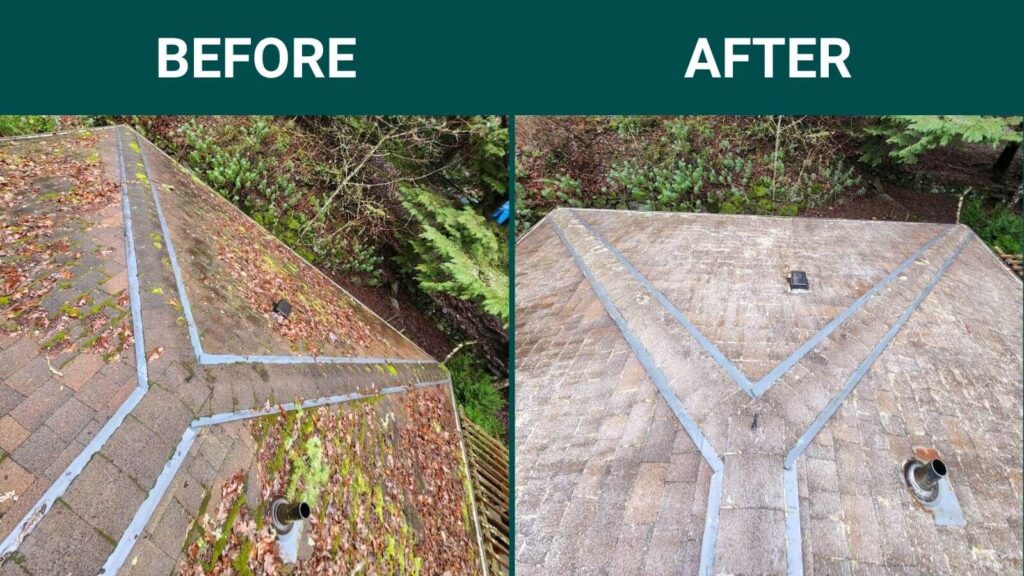
Do not climb onto a mossy, wet or steep roof to do this. If moss is the reason your gutters fill with green grit every winter, the fix is soft wash roof cleaning, not a broom.
Step 4: Open Up the Downspout Outlet First
Start at the downspout, not at the far end. Pull out any strainer and clear the debris packed around the outlet hole by hand.
This one change makes the whole job easier. When you flush later, the water has somewhere to go instead of backing up over the lip and onto you.
Step 5: Scoop and Bag the Debris
Work away from the downspout along the run. Scoop the debris into a bucket hooked to the ladder or straight into a yard bag. A tarp below catches what you miss.
A few details that separate a tidy job from a messy one:
- Lift, do not push. Pushing debris along the trough drives it toward the outlet you just cleared.
- Do not fling it into the beds. Rotting leaf mold stains siding, smothers plants and blows back onto the roof. Bag it and compost it if you like.
- Lift any gutter guards and clear underneath. Fine needles and roof grit get past most guard styles and build up out of sight.
- Check the corners and seams. Debris piles up where the gutter changes direction.
Step 6: Flush the Gutter With a Hose
Go to the end of the run farthest from the downspout. Run the hose along the trough, not at the roof, and push the remaining grit toward the outlet.
Watch how the water behaves. It should move steadily to the downspout. If it sits in a puddle mid-run, that section has sagged or a hanger has let go. If it drips from a joint, the seam sealant has failed. Make a note of both; they matter more than any leaf.
Step 7: Prove Every Downspout Drains
A downspout is clear when water poured in at the top comes out the bottom at full flow, with no backing up at the gutter. Anything less means there is still a blockage.
Work through these in order and stop as soon as water runs freely:
- Flush from the top. Put the hose into the outlet and turn it up full.
- Flush from the bottom. Feed the hose up from the lower end. Reverse pressure often shifts a plug that top-down water compacts.
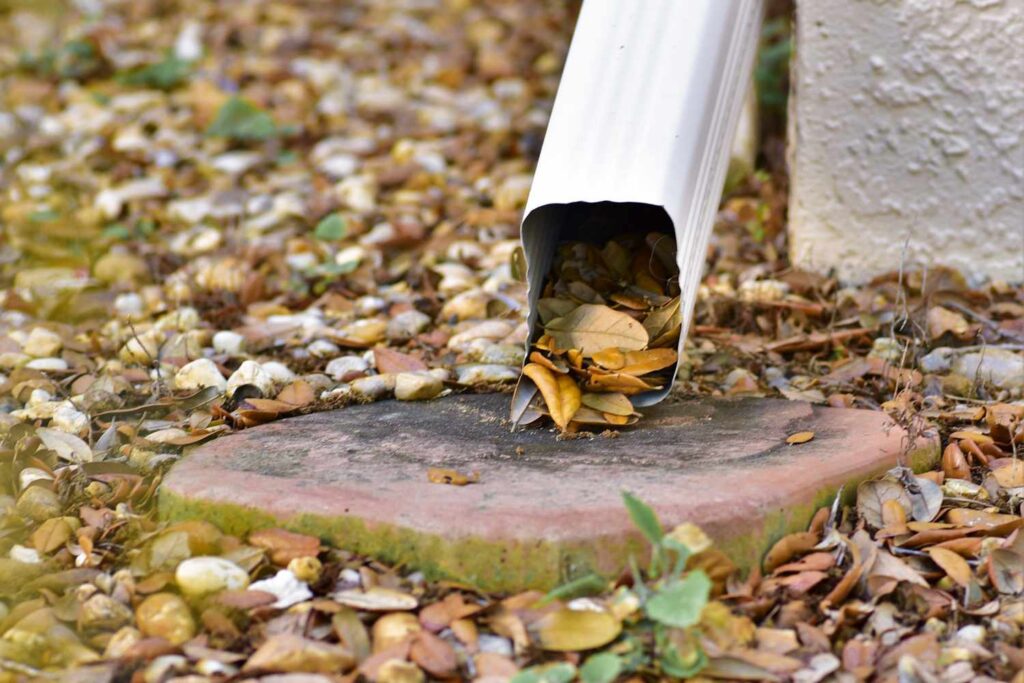
- Check the elbows. Most clogs lodge in the bends. Remove the screws at the bottom elbow, clear it, and refit.
- Use a plumber’s snake for packed debris further up the pipe.
- Underground drain lines are a different job. If the downspout drains into a buried pipe and the water still backs up once the downspout itself is clear, the blockage is below ground and usually needs a drain specialist.
For the warning signs that a downspout has been blocked for a while, see our guide to signs of a clogged downspout.
Step 8: Check Where the Water Goes
Here is the step almost every guide leaves out. A perfectly clean gutter does no good if it empties next to the foundation.
For homes that drain onto the ground, the City of Portland’s downspout guidance calls for discharging at least 6 feet from a basement and at least 2 feet from a crawl space or slab foundation, as well as 5 feet from a neighbor’s property line and 3 feet from a public sidewalk (Portland.gov, Downspout Disconnection). Those are Portland’s numbers, but they are a sensible benchmark anywhere in the region. A downspout extension or splash block is an easy fix.
While you are down there, look along the fascia board (the board the gutter is fixed to) for dark staining or soft spots. Water running over the gutter lip rots fascia over a winter, and that repair needs a carpenter, not a cleaner. More on the knock-on damage in what clogged gutters do to your home.
Optional: Clean the Outside of the Gutters
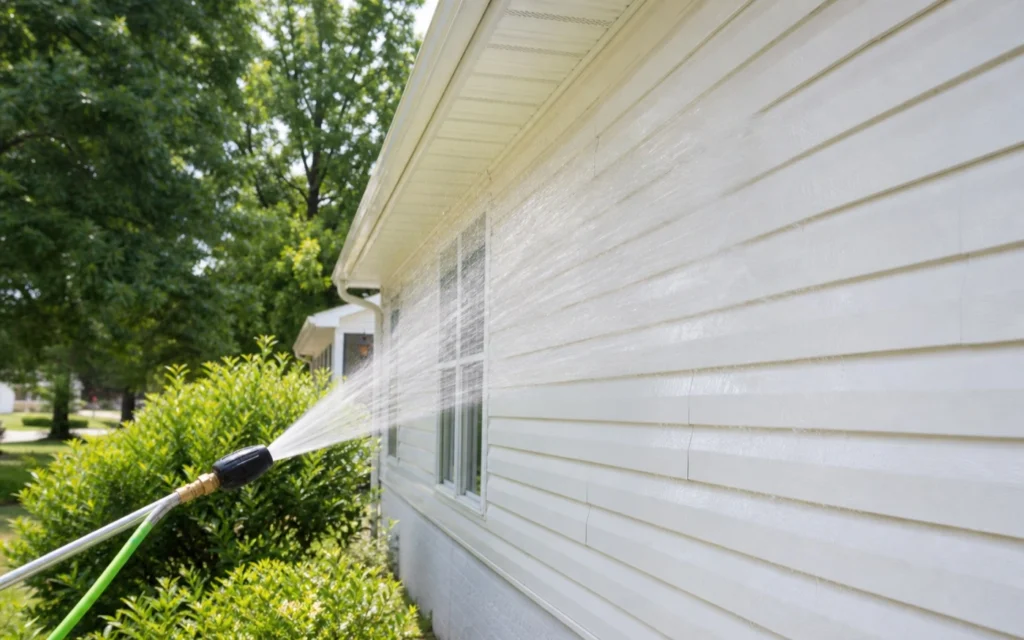
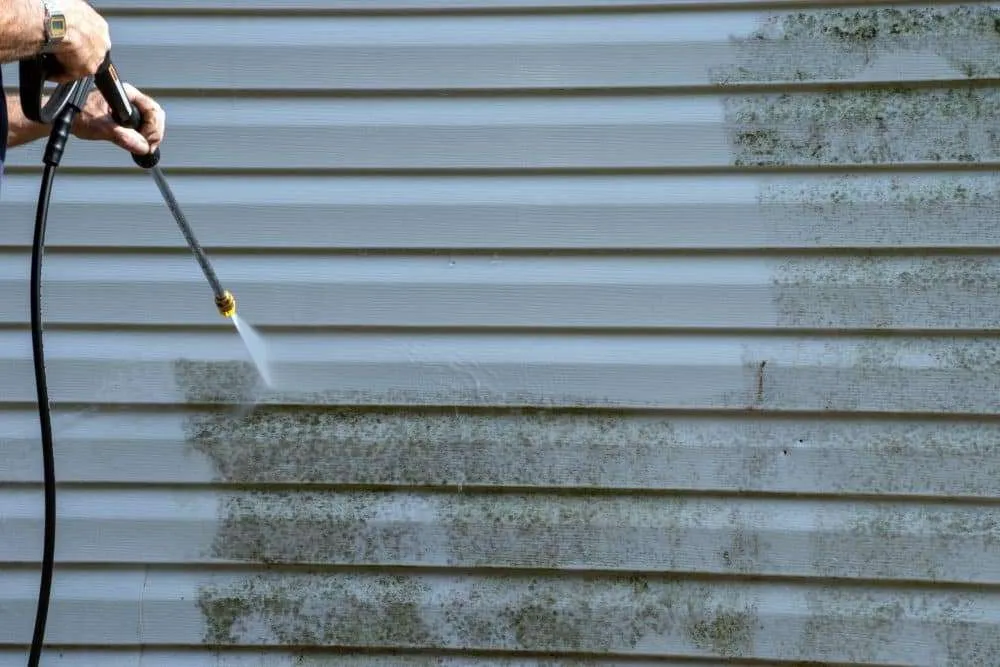
Those dark vertical streaks on the face of the gutter are often called “tiger stripes.” They form where dirty water and roof runoff spill over and dry on the surface. A soft brush on an extension pole with a mild, plant-safe cleaner removes light staining. Heavy streaking on the gutters and the siding below comes off with soft wash house washing.
Not keen on the ladder? NJM clears gutters by hand, bags and removes the debris, and flushes every downspout until it runs clear. Address and number of stories is usually all we need to quote. Get a free gutter cleaning quote or call (971) 328-2122.
Cleaning Gutters From the Ground: What Works and What Doesn’t
You can clean gutters from the ground using a curved hose wand, a leaf blower gutter kit, a wet/dry vacuum with a gutter attachment, or a telescopic scoop. Each suits a different kind of debris, and none of them replace checking the downspouts.
Ground-level cleaning is the safest option for two-story homes if you are determined to do it yourself. The trade-off is that you cannot see inside the gutter, so you are guessing whether it is actually clear.
| Method | Best for | Weak spot | Our verdict |
| Curved hose wand | Light debris and flushing after a clean | Wet, packed leaves just get wetter and heavier | Good for maintenance between proper cleans |
| Leaf blower gutter kit | Dry leaves on single-story runs | Useless on wet debris, which is most of the year west of the Cascades. Sprays debris over the house and garden | Only in a dry spell, and wear eye protection |
| Wet/dry vacuum with gutter tubes | Wet sludge and needles | Heavy at full extension, and the canister fills fast | The best ground option for Pacific Northwest debris |
| Telescopic scoop or grabber | Small clumps you can see | Slow, and awkward at two-story height | Fine for spot fixes |
| Pressure washer wand | Hardened grime in the trough | Easy to drive water up under shingles or through seams, and it throws mud everywhere | Avoid unless you really know what you are doing |
| Gutter camera or phone on a pole | Checking your work | Does not clean anything | Worth it. It is the only way to know the job is done |
A useful trick for ground-level downspout clogs: hold a leaf blower nozzle against the bottom opening and blow upward. It often shifts a plug sitting at the top outlet.
What Not to Do When Cleaning Gutters
These mistakes turn a two-hour job into a repair bill.
- Pointing a pressure washer up the roof. High-pressure water can lift shingles and force water under them.
- Leaning the ladder on the gutter. It dents the trough and can pull hangers out of the fascia.
- Standing on the top rung or the top of a stepladder. The labels on the ladder say so for a reason.
- Walking a mossy or wet roof. It is slippery, and moss-softened shingles break underfoot.
- Blowing debris into the garden. It relocates the problem and stains siding and paving.
- Cleaning the gutter but not the downspout. A clear gutter draining into a blocked downspout still overflows.
- Ignoring sagging sections. Standing water in a sagging run adds weight every storm until the hangers give up.
Pacific Northwest Adjustments Most Guides Miss
National guides are written for oaks and maples that drop their leaves over a few weeks in autumn. Homes around Portland, St. Helens and Scappoose deal with different debris, and the job needs a few changes.
Conifers shed all year. Douglas fir and other evergreens drop needles and cones in every season, not just in October. Needles are small enough to slip past many gutter guards and pack tightly into downspouts, where they turn into a mat that sheds water like felt.
Debris rarely dries out. Between October and spring, gutters here tend to stay wet. Wet debris mats down and grows moss and even seedlings. That is why a leaf blower that works fine in a dry climate often just smears sludge along the trough.
Roof moss becomes gutter grit. Moss on the roof breaks down and washes into gutters as green grit that settles in the bottom of the trough and the elbows. Cleaning gutters without dealing with the roof means cleaning them again sooner. Our guide on how to remove moss from a roof explains the safe options.
Guards change what builds up, not whether it builds up. Guards keep out whole leaves but not needles and grit. Lift them and check underneath at least once a year. If you are weighing up guards, read whether gutter guards are worth it first.
Timing matters before the rain sets in. A clean after most of the leaves have fallen and before the heavy winter rain is the one that matters most here. We explain the reasoning in why fall is the best time to clean gutters. Clear gutters also help during the occasional cold snap; see our Oregon ice dam prevention guide.
How Often Should You Clean Gutters Here?
Most homes need gutters cleaned at least twice a year, in late spring and late fall. Homes with conifers directly over the roofline often need three cleanings a year, because evergreens shed needles in every season.
Treat twice a year as a minimum, not a target. The things that push you toward more frequent cleaning are trees over the roof, long gutter runs served by only one downspout, a mossy roof and guards that trap fine debris. After a big windstorm, do a quick check from the ground using our post-storm gutter checklist.
When to Stop and Call a Professional
Climb down and hand the job over if any of these happen:
- You would need to stand higher than the rungs your ladder allows, or reach beyond your shoulders.
- The gutter is pulling away from the fascia, or a section moves when you touch it.
- Water still backs up after you have cleared the downspout itself, which points to an underground blockage.
- You find soft, rotten fascia or signs of water getting behind the gutter.
- There are wasp nests, rodents or a bird’s nest in the run.
- The gutters are overflowing during a storm right now. Our emergency gutter cleaning page covers what to do while you wait.
If you are wondering whether hiring it out is worth it, our breakdown of how much gutter cleaning costs covers what drives the price, including stories, run length and guards.
Two stories, or just done with ladders? NJM cleans gutters across Columbia County, the Portland metro and SW Washington, including St. Helens, Scappoose and Portland. Everything is removed by hand and hauled away, never blown into your yard. Request your free quote.
Frequently Asked Questions About Cleaning Gutters
What is the easiest way to clean gutters?
The easiest way to clean gutters on a single-story home is to scoop the debris by hand into a bucket from a well-placed extension ladder, then flush the gutter and downspouts with a garden hose. On two-story homes, a wet/dry vacuum with gutter extension tubes lets you clean from the ground without climbing.
What should you not use to clean gutters?
Avoid pressure washers aimed up the roof, metal scrapers on aluminum gutters, bleach or harsh chemical cleaners, and leaf blowers on wet debris. Pressure washers can force water under shingles, metal tools scratch protective finishes and invite corrosion, and harsh chemicals can harm plants and damage gutter materials.
How can I clean my gutters without getting on the roof?
You can clean gutters without going on the roof by working from a ladder with a standoff, or by staying on the ground with a curved hose wand, a leaf blower gutter kit or a wet/dry vacuum with gutter tubes. A camera or phone on a pole lets you check the result from below.
How often should gutters be cleaned?
Gutters should be cleaned at least twice a year, in late spring and late fall. Homes under evergreen trees, which shed needles all year, often need three cleanings. In the Pacific Northwest, the most important clean is after leaf fall and before the heavy winter rain begins.
How do I unclog a downspout?
To unclog a downspout, flush it from the top with a hose at full pressure, then feed the hose up from the bottom if water backs up. If that fails, remove the bottom elbow and clear it by hand, or use a plumber’s snake. If the downspout runs underground and still backs up, the blockage is probably in the buried pipe.
Should gutters be cleaned wet or dry?
Gutters are easiest to clean when the debris is damp but not soaked, usually a day or two after rain. Damp debris lifts out in clumps. Very dry debris turns to dust, and saturated debris becomes heavy sludge. Always work on a dry, calm day so the ladder and roof edge are not slippery.
Is it safe to clean gutters yourself?
Cleaning gutters yourself is reasonably safe on a single-story home if the ladder is on firm ground at a 4:1 angle and someone is there to steady it. Risk rises sharply on two-story homes, steep or mossy roofs and near power lines. Ladder falls send an average of more than 136,000 Americans to emergency rooms each year.
The Bottom Line on How to Clean Gutters
Knowing how to clean gutters comes down to three things: get up safely, get the debris out rather than moving it around, and prove the water leaves the gutter, leaves the downspout and leaves the foundation. Do that twice a year, or three times under firs, and your gutters will do their job all winter.
If the ladder part is where it falls apart, that is the part we are good at. Book professional gutter cleaning and we will clear, flush and test the whole system in one visit.