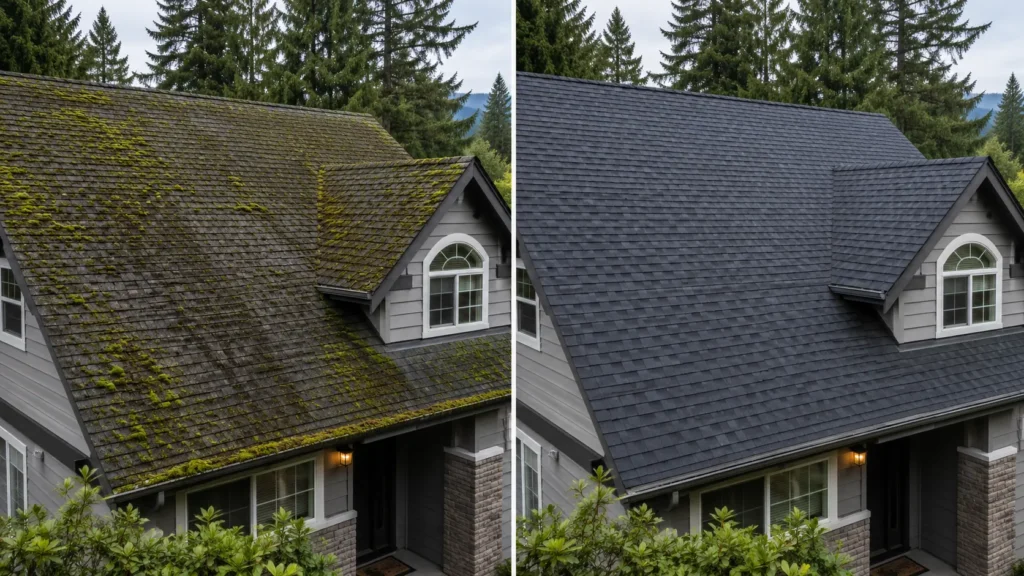
Soft wash roof cleaning uses a diluted sodium hypochlorite solution, not water force, to kill moss, algae and lichen at the root, then rinses the dead growth away at garden-hose pressure. The Asphalt Roofing Manufacturers Association specifies a 50:50 mix of laundry-strength chlorine bleach and water, a 15 to 20 minute dwell, and a low-pressure rinse. ARMA is blunt about the alternative: never use a pressure washer on an asphalt shingle roof, because it causes granule loss and very likely premature failure of the roof system. In Oregon a professional soft wash runs $300 to $600 and keeps a roof clear for one to three years.
What Soft Washing Actually Is
Soft washing inverts how most people assume roof cleaning works. There is no scrubbing, no blasting and no mechanical removal, the chemistry does the work, and the water only carries it on and rinses it off. A soft wash rig applies solution at roughly 40 to 80 PSI, a fraction of the 1,200 to 3,000 PSI a pressure washer produces. It soaks into the colonies, kills them at the cellular level, and what is left dies and washes away over the following weeks of Oregon rain.
The organisms being targeted are specific, and they are not the same problem:
- Black streaks are Gloeocapsa magma, a blue-green algae that grows a dark pigmented sheath to shield itself from UV light.
- Green cushions on north-facing slopes are moss, a non-vascular plant that absorbs water through its leaves rather than roots — which is why it only survives where a roof stays damp.
- Crusty grey-green patches that look painted on are lichen, an algae-and-fungus partnership that grips granules hard enough to pull them off if scraped.
ARMA draws a distinction most cleaning companies gloss over. There is no scientific evidence that algae damages asphalt shingles, it is an appearance problem, and a performance problem on reflective “cool” roofs. Moss is the one that does structural harm: it lifts and curls shingle edges, raising blow-off risk in wind, and in bad cases drives water sideways under the shingles into the roof deck.
That should change how you schedule. Black streaks are a curb appeal problem on your timetable. Moss is a damage clock already running.
What Is Actually in the Tank
This is the part most roof cleaning pages skip. Here are the real numbers.
ARMA’s published specification is a 50:50 mix of laundry-strength liquid chlorine bleach and water. Household bleach is roughly 5 to 6 percent sodium hypochlorite, so that puts about 2.5 to 3 percent on the roof.
Professional equipment starts stronger. Contractor-grade sodium hypochlorite comes at 10 to 12.5 percent, so reaching that same working strength means roughly one part solution to three parts water. Most professional roof mixes land between 1.5 and 4 percent at the surface, adjusted to what is growing:
| What is on the roof | Typical working strength |
|---|---|
| Light algae streaking, recently appeared | ≈ 1.5 – 2% |
| Established algae, light moss | ≈ 2 – 3% |
| Heavy moss and lichen | ≈ 3 – 4% |
A surfactant goes in at a small percentage. It is not a cleaner, it thickens the solution so it clings to a pitch instead of running straight into the gutter, which is what buys you dwell time.
Dwell time is 15 to 20 minutes per ARMA, longer for heavy moss. The rule broken most often is that the solution must not dry completely on the roof, once it dries it cannot be rinsed off properly. That is why soft washing is a poor idea on a hot afternoon and a good one on an overcast Oregon morning.
Why ARMA and Shingle Manufacturers Specify Low Pressure
An asphalt shingle is a fibreglass mat saturated in asphalt, with ceramic-coated granules pressed into the surface while the asphalt is still hot. Those granules are the shingle’s entire UV defence. Strip them and the asphalt underneath is exposed to direct sunlight, where it oxidises, hardens, cracks and fails.
Granules are held by adhesion into partially cooled asphalt, not bonded like glass in a frame. A 2,500 PSI jet held a few inches off the surface takes them off in sheets, and the damage stays invisible from the ground for months, until granule sediment shows up in the gutters and a bald patch appears on a sun-facing slope.
ARMA’s wording leaves no room for interpretation: never use a pressure washer to clean an asphalt shingle roof, as this will cause granule loss and very likely premature failure of the roof system. Its algae bulletin extends the same warning to brushes and brooms.
This is where the warranty question lands. Shingle warranties cover manufacturing defects, not damage from improper maintenance, so a roof showing pressure-washer granule loss gives a manufacturer a straightforward reason to deny a claim. On a $12,000 roof, that is an expensive $200 saving.
One nuance worth knowing: mixing instructions vary by manufacturer. ARMA publishes the general specification, but GAF, Owens Corning and CertainTeed each issue their own technical bulletins, and the right answer for your roof is the one from the company that made your shingles.
Soft Wash vs Pressure Washing a Roof
| Soft wash | Pressure washing | |
|---|---|---|
| Working pressure | 40–80 PSI (garden hose) | 1,200–3,000+ PSI |
| What does the cleaning | Diluted sodium hypochlorite | Water force |
| Effect on granules | None at these pressures | Strips granules; ARMA warns of premature roof failure |
| Kills the organism? | Yes, root and spore | No, surface removal only |
| Effect on lichen | Killed, releases over weeks | Torn off with granules still attached |
| ARMA position | The specified method | Explicitly warned against |
| Warranty exposure | None | Grounds for a denied claim |
| How long results last | 1–3 years in Oregon | Months, the roots survive |
| Typical Oregon cost | $300–$600 | Less up front, far more later |
| What it is right for | Roofs, siding, painted trim | Concrete, driveways, patios, stone |
Pressure washing is a good tool. It is simply the wrong tool for a roof. Everything it does well, driveways, walkways, patios, it does well precisely because those surfaces have nothing on them a jet of water can remove.
What a Soft Wash Job Actually Looks Like, Hour by Hour
A standard single-storey Oregon home takes about three and a half hours.
0:00 – 0:20 — Walk-around and assessment
The technician identifies what is growing, checks shingle condition and existing granule loss, notes pitch and access, and confirms the shingle manufacturer where possible. Any damage already there is photographed before solution is mixed.
0:20 – 0:45 — Landscape protection
Everything under the drip line is saturated with plain water first, so drift lands on wet foliage and runs off instead of soaking in. Specimen plants get tarped; furniture, vehicles and pet bowls are moved.
0:45 – 1:00 — Debris clearing
Needles, leaves and branch litter come off with a leaf blower, air directed down the slope so nothing is driven under the shingle edges.
1:00 – 1:45 — Solution application
Ridge down, in overlapping passes, so runoff always flows over untreated surface rather than back across cleaned areas. Most of it is applied from a ladder or by extension — nobody stands on a wet roof longer than the job requires.
1:45 – 2:15 — Dwell
Fifteen to twenty minutes minimum. Black streaks visibly fade and heavy moss turns dull olive. Any section drying too fast gets re-wet, and so does the landscaping.
2:15 – 3:00 — Low-pressure rinse
Same 40 to 80 PSI, ridge to eave. Moss is deliberately not scrubbed or scraped, that is what tears granules off.
3:00 – 3:30 — Landscape rinse and walk-through
Everything is rinsed a second time and the gutters cleared of whatever washed down. After photos, then a walk-through with the homeowner.
The two to six weeks afterwards. Algae staining is gone immediately. Moss is not, it dries, greys, loses its grip and washes off gradually with rain, so expect a patchy roof for several weeks and moss debris in the gutters. That is the treatment working, not failing. ARMA notes severe moss can need more than one treatment.
How Long Soft Washing Lasts in Oregon
One to three years for most Portland-area homes before moss reappears; algae staining stays away longer. Where a roof lands in that range comes down to four things:
- Sun exposure. North-facing slopes stay damp longest and regrow first, often a year or more before the south side shows anything.
- Tree canopy. Douglas fir, cedar and big-leaf maple drop debris that holds moisture and feeds moss. A roof under heavy canopy in Scappoose regrows faster than an open lot in Beaverton.
- Gutter maintenance. Blocked gutters back water up under the bottom course of shingles and keep the eave permanently damp. ARMA also warns against letting an upper roof’s downspout discharge onto a lower roof.
- Debris clearing between washes. Blowing needles off the roof once or twice a year extends a treatment more than anything else a homeowner can do.
Worth correcting, because a lot of roof cleaning advice gets this wrong: retrofitting zinc or copper strips to an existing roof is not recommended. ARMA’s position is that fitting them requires either exposed nails, which can leak over time, or breaking the shingle sealant bond to slide them under, which can cause wind damage later. Zinc granules built into shingles at manufacture work fine — but that decision belongs to a re-roof, not a maintenance visit.
What Soft Washing Costs in Oregon
Three hundred to six hundred dollars for a standard single-family home in the Portland Metro area. What moves the number:
- Roof area and pitch. A steep pitch means harness work and slower, more careful application.
- Severity. Heavy moss and lichen need a stronger mix, a longer dwell and sometimes a second visit.
- Access. Two storeys, complex rooflines, tight side yards and no nearby spigot all add time.
- Roof material. Cedar, tile and metal each need an adjusted approach.
Set against a Portland-area re-roof at $10,000 to $18,000, a soft wash every couple of years reads less like a cosmetic expense and more like cheap insurance.
Which Roofs Can Be Soft Washed
Asphalt shingle is the most common and the most straightforward. Cedar shake, concrete and clay tile, metal and slate can all be soft washed too, but each needs a different solution strength and dwell time. Cedar is unforgiving of an over-strength mix; tile is more about not walking on it than about chemistry.
What Soft Washing Will Not Do
Being straight about the limits:
- It will not repair a failing roof. If shingles are curling, cracked or already shedding granules, cleaning makes the problem visible, not gone.
- It will not remove moss instantly. Moss dies on contact and leaves over weeks.
- It is not permanent. In this climate nothing is. One to three years is the honest window.
- It will not fix ponding, flashing failure or ventilation problems. Those are roofing jobs, not cleaning jobs.
- It is not a safe DIY project. ARMA’s own guidance is that only trained professionals should work on a roof. A wet, sloped, treated surface is a dangerous place to stand, and a mis-mixed solution can stain siding and kill landscaping in one pass.
Frequently Asked Questions
Is soft wash roof cleaning safe for asphalt shingles?
Yes. Low-pressure chemical cleaning is the method ARMA specifies for algae and moss on asphalt roofs. At 40 to 80 PSI there is no mechanical force acting on the granules, which is what makes it safe. The damage ARMA warns about comes from pressure washers, brushes and brooms.
Will soft washing kill my plants or harm my pets?
Not when it is done properly. Landscaping is saturated with plain water before any solution goes on, so drift lands on wet foliage and runs off, and everything is rinsed again at the end. Keep pets and children off treated areas until the final rinse has dried.
How often should an Oregon roof be soft washed?
Every one to three years for most Portland-area homes. North-facing slopes and roofs under heavy Douglas fir or maple canopy sit at the short end; open, sunny lots go longer. Clearing debris once or twice a year between treatments pushes the interval out.
Does soft washing remove black streaks?
Yes, and it is the fastest visible result of the job. Black streaking is Gloeocapsa magma, a blue-green algae, and it typically clears during the 15 to 20 minute dwell rather than taking weeks like moss does.
Will soft washing void my shingle warranty?
No — the opposite risk is the real one. Pressure washing can give a manufacturer grounds to deny a claim, because granule loss from high-pressure water counts as damage from improper maintenance rather than a manufacturing defect. Mixing instructions vary by manufacturer, so it helps to know whose shingles you have.
Can I soft wash my own roof?
ARMA’s guidance is that only trained professionals should work on a roof. Beyond the fall risk on a wet, sloped, treated surface, a mis-mixed solution can bleach siding and kill landscaping, and sodium hypochlorite reacts badly with the organic pigments in some paint colours.
Should gutters be cleaned before or after a soft wash?
After. The wash loosens dead moss and debris that ends up in the gutters, so cleaning them first means doing the job twice. Booking both together is usually cheaper than booking them separately.
Why does my roof still look patchy a week after cleaning?
Because dead moss takes time to let go. It dries, greys and washes off over two to six weeks of rain rather than disappearing on the day. Algae goes immediately, moss does not — a patchy roof at one week is the treatment working.
Get Your Roof Assessed
NJM Roof & Gutter Cleaning is a licensed and insured Oregon contractor (CCB #252799) with a 4.9-star rating from more than 130 Google reviews. We soft wash roofs across St. Helens, Scappoose, Warren, Deer Island, Columbia City, Beaverton, Hillsboro and the wider Portland Metro area. Every quote is free and written.
Call (971) 328-2122 or request a quote online. Text us a photo of your roof and we can usually give you a number the same day.
